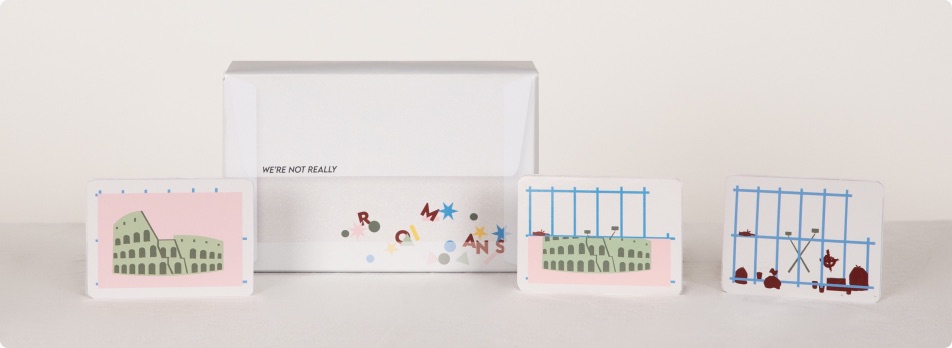
A card game that teaches Rome by letting people argue about it.
I found the problem in how Rome gets sold to visitors, set the thesis, designed the mechanic, produced the physical deck, and directed the film that pitched it.
2 programs
using the deck: Cornell in Rome, and CASTRO’s artist residency
AAP homepage
selected as featured student work
2025
Cornell in Rome Student Exhibition
CONTEXT
Rome’s image is the product. Lived experience isn’t in it.
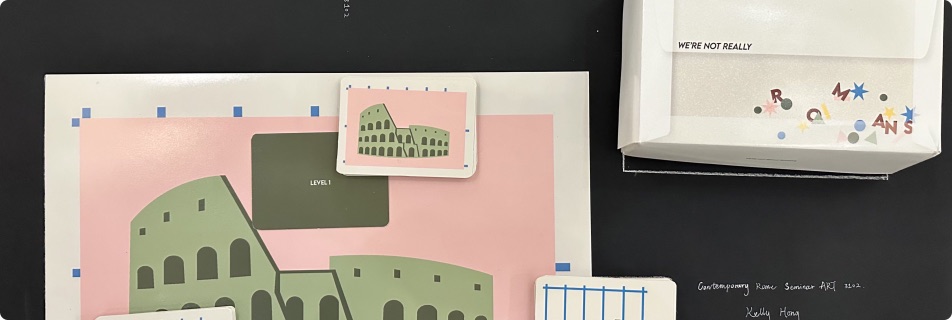
Inherited imagery versus the city underneath it.
Rome’s global image is shaped by romanticized narratives that flatten what living there is actually like. Spending a semester in the city, I watched tourism prioritize image over lived reality, for visitors and residents both. The project responds to that gap.
THE INSIGHT
Play lowers the price of uncomfortable questions.
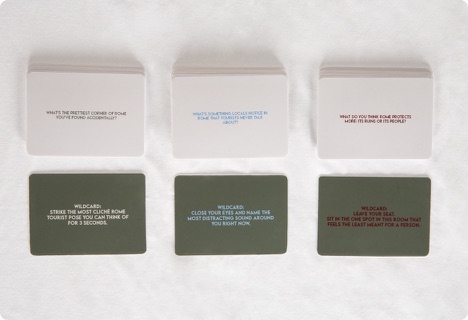
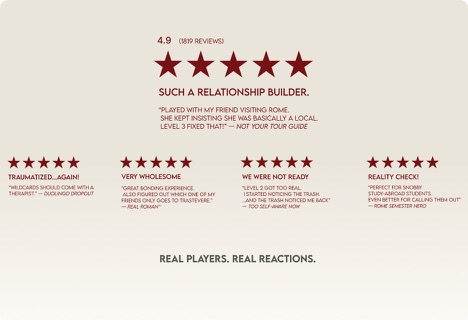
Real players, real reactions.
A game gives people a low-pressure way to sit with unfamiliar or uncomfortable ideas. The structure borrows from We’re Not Really Strangers: prompts that deepen gradually, so players move from surface-level assumptions toward reflection without ever being lectured.
The thesis: the strategic use of cuteness lowers the barrier to critical dialogue. Parody is the entry fee. Softness and ambiguity lower defensiveness, and understanding emerges through interaction rather than instruction.
THE PRODUCT
A brand system disguised as a party game.
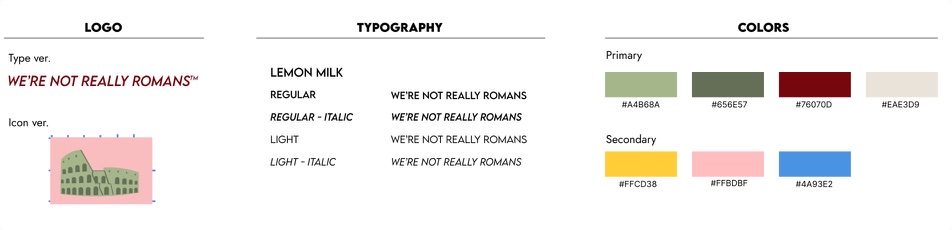
The branding guide, and the deck it produced.
A warm olive palette, rounded typography, and playful party-inspired graphics hold Rome’s chaotic energy while keeping the barrier to entry low. The key artwork borrows from construction hoarding: visuals that conceal and reveal at the same time, which is also what the prompts do.
Then I produced it: a manufactured deck, packaging, and a branding guide so the system survives without me in the room. The deck hangs in a show and runs in a classroom. It was designed to survive both.
THE CAMPAIGN
“You think you know Rome. But do you really?”
The pitch, and the room it activated.
The brand film ran at the Cornell in Rome exhibition, a video presentation that sold the deck into programs rather than onto shelves. But the film was not what convinced anyone. Visitors picked the cards up and started playing, right there in the gallery. A static exhibit turned into a room of people arguing about Rome, which is exactly what the deck was built to cause.
- OUTCOME
- • In active use at Cornell in Rome as a counter-mapping exercise
- • Adopted by CASTRO for its artist-in-residence program after seeing it played
- • Selected as featured student work on the Cornell AAP homepage
- • Exhibited at the Cornell in Rome 2025 Student Exhibition
AFTER
I designed it to be looked at. People played it instead.
I designed the deck to be looked at, and expected it to be looked at. People played it instead. Nobody asked them to, and the room changed because of it. The lesson I took: an object that invites use will outperform an object that explains itself, and I now design for the first thing.